
ExpatBuilds — Build Smarter. Avoid Mistakes. Take Control.
Why Building a Home in Mexico Can Start Smoothly and Then Feel Uncertain
Most expats begin their Mexico home construction journey with a mix of excitement, relief, and possibility. You envision a new chapter, a retreat of your own, and the excitement of creating a home that reflects your life abroad. At first, everything feels promising.
The first meeting with a builder feels promising.
The architect seems warm, professional, confident.
Everyone says, “Don’t worry, we’ll take care of it.”
And then… little cracks start to show.
Somewhere between early conversations and the start of the home building construction process, expats begin to feel something unexpected:
Uncertainty.
A “six-month máximo” timeline quietly stretches.
A budget that once felt solid suddenly shifts.
You’re not sure who is supervising the workers.
Permits seem vague.
Receipts are unclear.
Updates become sporadic.
You’re told, “Es normal… it’s how it works here.”
And the quiet question forms:
“Is this normal here? Or is something going wrong? …Or am I the problem?”
If you’ve wondered any of those questions — you’re not imagining it.
And no, it’s not your fault.
You’ve stepped into a construction ecosystem that operates very differently from what you’re used to in the U.S., Canada or Europe.
Once you understand how the construction ecosystem in Mexico truly works, you gain something powerful:
Clarity.
Confidence.
And the ability to regain control of your construction project — calmly and strategically.
The Invisible Forces Behind Mexico’s Construction System: Mexico’s Highly Informal Construction Landscape
To understand why so many construction projects drift off track, stall, or destabilize, we must first understand the environment where much of Mexico’s construction industry operates.
Mexico does have construction norms (NOMs), permitting processes, municipal regulations, and defined professional roles. But — the level of enforcement and formal oversight varies enormously depending on:
- Region
- Municipality
- Type of project
- Professionalism of the team
- Individual Builder, Contractor practices
Simply put, this creates a landscape where:
- Some builders follow rigorous standards
- Others operate informally
- Many mix both depending on:
- The client — and how familiar they seem with the process
- Location
- Scope
The Hard Data: High Informality Dominates Mexico’s Construction Industry
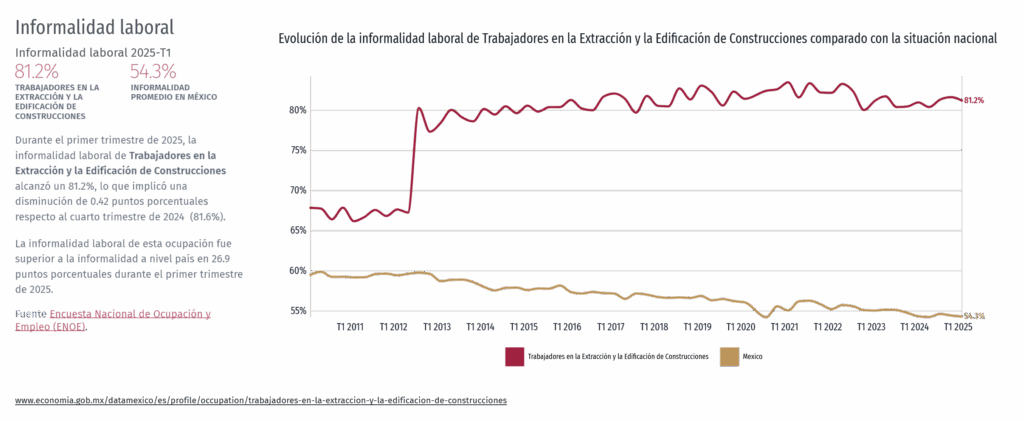
According to ENOE’s 2025 analysis, 81% of Mexico’s construction workers operate within the informal sector. This means standardized processes, documentation, and oversight are inconsistent or absent in much of the market. As a result:
- No single, unified building code
- Fragmented professional roles
- No formal payroll
- Inconsistent documentation
- Cash-based transactions
- Verbal agreements as cultural norm
- Flexible timelines, flexible scope
- Little formal project management
- Few administrative systems
- Limited cost-control systems
- Few mechanisms for accountability
This is not a question of “right or wrong.”
It is simply how the system functions.
The workers are skilled.
The maestros are talented.
Architects and engineers are often exceptional. That said, unless the client introduces structure, everyone — even skilled builders — operate on assumptions rather than aligned expectations.
What Happens When Global Construction Weakness Meets Mexican Informality
In Blog #1, we referenced global research from McKinsey & Company, which shows that construction worldwide suffers from:
- Inaccurate cost estimation
- Poor planning
- Inconsistent project management
- Delays caused by coordination gaps
- Reactive vs. proactive oversight
Now imagine these global challenges intersecting with Mexico’s informal construction environment.
High informality + low structure = unpredictable outcomes.
The result:
- Timelines shift
- Budgets drift
- Roles overlap
- Communication varies
- Assumptions multiply
- Accountability thins
Not because workers lack skill — Mexican builders, maestros, independent contractors and engineers are often exceptionally talented.
The issue is not skill.
It’s structure.
As a result, when these global tendencies meet Mexico’s informal construction habits, projects drift easily without structure. In regions where informality dominates, structure depends on you, the client — and that distinction drives everything.
What This Means for Expats: Predictable Construction Problems You Can’t See Coming
When informality meets expat expectations (highly structured construction environments), the same predictable patterns emerge. These aren’t coincidences — they are systemic friction points.
Expats come from environments where:
- Contracts are standardized
- Budgets are itemized
- Schedules include penalties for delays
- Builders are licensed
- Inspectors enforce codes and compliance
- Consumer protections are clear
But in Mexico — even though regulations exist — standardization, documentation, and enforcement vary.
This leads to a set of predictable challenges that repeat across thousands of expat projects.
1. Budgets Are Estimates, Not Commitments
In the U.S. or Canada, a budget is an itemized document tied to scope.
In Mexico, a presupuesto (budget) is typically:
- A general cost estimate
- Not broken down in detail
- They are flexible, Not binding
That leads to:
- Drifting totals
- Shifting allowances
- Frequent adjustments
- Budget overruns
This is why expat projects commonly run 30–60% over the initial estimate.
2. Timelines Are Flexible Targets, Not Commitments
Builders genuinely believe they can finish on time…
However:
- Scope changes
- Worker rotation
- Weather
- Subcontractors availability
- Material shortages
- Holidays and family obligations
- Informal scheduling make timelines fluid
Time is Flexible.
Schedules adapt.
Promises evolve.
Progress varies.
Workers shift based on availability and financial flow.
3. Contracts Are Not Standardized
Culturally, many people in Mexico prefer to work through:
- Trust
- Conversation
- Flexibility
It is culturally normal to build entire homes in Mexico with:
- Vague or verbal contracts
- 2–3 page agreements
- No Timeline or specifications
- No workmanship standards defined
This isn’t malicious — it’s simply the norm.
While that is the norm, it leads to drifting totals, shifting allowances, and frequent adjustments.
For locals accustomed to these norms, this works. For expats, it can feel uncertain.
4. Roles Overlap, Fragment, or Remain Undefined
In North America, a general contractor often handles everything.
- Materials procurement
- Labor
- Quality
- Schedule
- Costs
- Inspections
- Permits
- Everything, supported by a full team of staff with clearly defined roles and SOPs
In Mexico, these responsibilities are usually divided across:
- Arquitecto
- Maestro de obra
- DRO (Director Responsable de Obra)
- Ingeniero
- Structural specialist
- Builder/Contractor
- Foreman
For that reason, unless you establish clarity, each assumes someone else “has it.” Without clear structure, tasks fall through cracks unintentionally.
If none of these people create structure…
the responsibility falls on you, to clarify roles and responsibilities from the start.
5. Communication Gaps Are Guaranteed
Not because of language issue — it’s a cultural workflow, because of different expectations of formality, updates, accountability, documentation and assumptions:
You assume something is included
They assume you’ll mention it if it’s important
You assume updates will be provided
They assume you’ll ask
You assume a budget is fixed
They assume it’s flexible
This is how misunderstandings happen — not out of malice, but out of differing expectations.
That is where construction projects fall apart — not because someone is wrong, but because no one aligned expectations on paper.
Yet none of it is personal.
It’s cultural, it’s the invisible system that drives the informal construction industry in Mexico.
Why It Feels Personal (But Isn’t)

This is the point where expats start to feel frustration, disappointment, or even fear, because everything feels personal:
- “Why didn’t he tell me?”
- “Why did they change the price?”
- “Why wasn’t that done right?”
- “Why didn’t they plan better?”
The truth — and the relief:
It isn’t personal.
It’s systemic, inherent in the informal construction industry system.
Mexican builders — even excellent ones — are operating in a system that assumes:
- Verbal communication
- Flexible scope
- Client presence
- Decisions made as you go
- Mutual adjustment, not strict rules
Most builders and architects are working within norms that function perfectly well for Mexican clients.
Most Mexican clients typically:
- Are on-site daily
- Accept flexible timelines
- Pay as they go
- Don’t use formal documentation
- Understand the rhythms of informality
For them, this is normal, how the system works.
In contrast, for expats accustomed to structure, it feels chaotic.
Again — not because anyone is wrong.
But because the systems are different.
This Isn’t About Blame — It’s About Systems
The most important truth expats must understand is this:
Mexican builders — even the excellent ones — operate in an ecosystem that benefits from the client defining the structure.
Many contractors are highly skilled.
They produce phenomenal work.
Many are proactive, communicative, have experience working with expats and are deeply invested in client satisfaction.
But the majority of informal contractors — even the excellent ones — were trained on the job, not through formal project management or financial-costing programs that deliver accuracy.
They operate in an ecosystem where structure from the client is welcomed but not expected.
The reality is, most learned construction the same way generations before them did:
- Apprenticeship
- Experience
- Family trades
- Hands-on learning
Which means, few received training in:
- Cost estimation
- Budgeting
- Procurement controls
- Financial management
- Project forecasting
- Risk mitigation
- Documentation systems
- Administrative systems
- Project Management
- Payroll
As a result, they are often brilliant builders, but not necessarily skilled at managing the finances or trained project managers.
This is why projects drift — not due to bad intentions…
…but because no one has defined the structure.
Simply put, projects drift unless the client introduces clarity and structure.
The Hard Truth Expats Need to Hear: In Mexico’s Construction System, the Client Must Provide the Structure
In countries like the U.S., Canada, or the U.K., the system protects the client with:
- Licensing boards
- Inspections
- Codes
- Legal standards
- Contract norms
- Consumer protections
- Clear accountability
However, in Mexico, building a home operates differently.
It is a buyer-responsibility system, where your construction project benefits from you introducing the structure the process needs.
Mexico does have construction norms and regulations, but enforcement and formal oversight vary significantly by region, municipality, and project.
Because of this, your own structure, documentation, and supervision become essential safeguards, not optional additions.
It’s a system where you must establish:
- Structure
- Clarity
- Documentation
- Accountability
Without these, projects tend to follow the rhythms of informality.
And when that happens:
- Budgets drift
- Timelines expand
- Communication breaks down
- Assumptions pile up
- Stress rises on both sides
But when you introduce structure — even simple, respectful, well-communicated structure — everything changes:
- Expats gain clarity
- Builders gain stability
- The project gains direction
When structure is missing, the project defaults to informality.
And you enter the construction process unprotected.
This is the turning point.
It’s where uncertainty shifts into control.
Case Example: How One Expat Couple Got Their Build Back on Track— and Their Builder Thrived
Take for example, a couple in Baja hired a contractor and began construction with excitement and trust.
But midway, they noticed:
- Slow Progress
- Fewer workers on-site
- A drifting presupuesto
- Rising material requests
- Shifting weekly payment amounts
- Confidence dropped
They weren’t sure whether this was “normal” — or a warning sign.
They approached their builder, they weren’t looking for confrontation; they simply wanted clarity and certainty.
What they introduced next changed the entire project.
Expats Introduced Structure — calmly, respectfully, and consistently.
And what followed was remarkable:
1. A clear, itemized budget revealed overcharges
When the couple reviewed receipts alongside a list of material, they discovered overstated quantities and discussed the errors with their contractor. The contractor was using “old school methods” to estimate material quantities.
A new simple system was introduced to help with the estimation of materials, timeline and payment process for the remainder of the project.
The local ferretería issued a refund for the extra materials on the contractor’s list — significant enough that it covered the cost of hiring help to implement the structure and prevent future misalignments and budget overruns.
2. Material tracking introduced accountability
Once materials were documented and verified, discrepancies vanished.
Everyone now knew what had been bought, used, and stored.
3. Expectations became clear — and predictable
The contractor understood decisions were being made from documentation, not assumptions.
Tension decreased.
Confidence increased.
4. Payments aligned with work
Not prepayments.
Not promises.
5. The contractor adapted — and eventually excelled
At first, there was an adjustment period, the added structure felt unfamiliar to him. Quantifying materials and planning the work ahead of time was new — it left little room for improvisation.
But slowly, he embraced it, he realized that he:
- Could finally see whether he was making or losing money
- Price more accurately
- Could plan better
- Gained confidence in his own process
- Could avoid losses
By the end of the construction project:
- The project finished beautifully
- Their relationship strengthened
- The contractor gained tools for pricing more effectively in future jobs
- The owners felt secure, confident, and respected
This is the power of structure — it protects both sides.
This is the untold truth rarely discussed in conversations about Mexico real estate or construction. Structure supports everyone.
Why Expats Must Provide the Structure
Building a home in Mexico is not inherently risky.
Building without clarity is.
When you understand how the system works — and what the system expects from you — you gain the power to:
- Protect your budget
- Stabilize your timeline
- Improve Communication
- Maintain your peace of mind
- Improve quality
- Build with confidence
Every successful expat project has one thing in common:
The client understood their role — and led the project with clarity.
What Smart Expats Do Differently When Building in Mexico
Here are the principles that successful expats follow for their construction project:
1. They define their project early
Clear scope = fewer surprises.
2. They clarify roles and responsibilities
Everyone knows what they own.
3. They expect cost transparency
Not micromanagement — just clear visibility into spending.
4. They define agreements on paper
Smart expats ensure that agreements remain alighted through contracts
5. They maintain consistent oversight
Not intrusive — simply staying aware.
These principles are the foundation of every successful construction project home build in Mexico.
The detailed frameworks behind them are what ExpatBuilds teaches in its tools, workshops, and 1:1 advisory for expats to avoid costly mistakes.
Your knowledge and oversight are what keep the project on track—aligned with your vision, your budget, and your peace of mind.
You Deserve a Smarter Way of Building in Mexico
Building a home in Mexico is one of the most meaningful, rewarding experiences an expat can have — when you have the right information, clarity, and support.
You deserve:
- Confidence
- Transparency
- Peace of mind
- A clear path forward
- A home you’re proud of
And that begins with understanding the system — and implementing the clarity that protects your dream.
At ExpatBuilds, we believe you deserve:
A home that reflects your vision.
The process that protects your investment.
Clarity, confidence, and peace of mind.
And with the right structure and support,
you absolutely can.